



What is dementia?
- Dementia is the name given to a collection of symptoms that occur when the brain becomes damaged through disease. The disease causes loss of brain cells and the brain subsequently reduces in size. This damage to the brain changes the way that the brain functions and how a person responds to and copes with daily living.
- There are many diseases with symptoms described as ‘dementia’ The most common is Alzheimer’s disease.
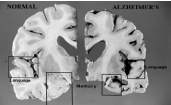
- This picture illustrates the
difference
between the post mortem ‘normal’
brain and the post mortem brain of
someone who had Alzheimer’s disease.* - Dementias are usually progressive which means that they get worse and cannot be cured.
- No two people will respond to dementia in the same way although there are similarities within each disease.
What happens with dementia?
As a result of brain damage due to dementia, people may experience problems with:
- Memory loss, especially short term memory loss.
- Interpreting what is going on around them.
- Thinking things through, concentrating.
- Understanding instructions.
- Initiating, or starting, something.
- Calculating risk.
- Learning new things.
- Identifying familiar objects, places, people.
- Using reason and judgement.
- Being able to plan, forecast.
What happens with dementia?
- Try to put yourself in the person’s situation and understand what they might be trying to say or what they are feeling and relate to that.
- If memory loss is a problem, give tactful prompts about what time of day it is, what day it is, what you are going to do next.
- A regular routine might help a person feel more secure and make it easier for them to remember what usually happens during the day.
- Try not to contradict the person or get into an argument – you’ll both end up exhausted! Try to ‘go with the flow’ and acknowledge what the person has said, even if you know it’s incorrect.
- Involve the person with daily activities and events, to keep their skills alive and be part of what is going on around them.
- Break down tasks into sections that can be achieved step by step. For instance, lay out clothes in the order that they will be put on.
- You might both find it enjoyable to share some happy memories
from the past. Photographs and
souvenirs may help jog
a memory. A person who has short term memory loss may be able to remember
things from long ago quite clearly. - Using questions that start with ‘What / Where / How / Who / When’ may be quite challenging to a person who has difficulty remembering so it might be worth trying to avoid those.
- Sing!! Singing with a person who has dementia has been found to be an effective means of communication. Melody and rhythm can help a person who has become ‘stuck’ with their language or movement. A person with quite developed dementia and word finding difficulty may still be able to sing songs learned in their youth. Using these retained skills as part of the care you give to a person with dementia, may help their sense of well being and selfesteem.
- Smile! Enjoy your time together – and don’t forget to look after
yourself.

* Picture courtesy of Department of Pathology, University of Oklahoma
© Guideposts Trust Ltd. Registered Charity no. 272619 – not to be
reproduced without prior permission